

Introduction
I still remember the first time I opened a company’s balance sheet during a training session in my first job.
It looked structured, clean, and professional. But honestly, I had no idea what I was looking at.
There were numbers everywhere and terms like “assets,” “liabilities,” and “networth” were used that looked like alien to me.
I’m an engineer, and it felt like a balance sheet is something only finance professionals could understand.
But over the years, I sat down and started reading it slowly. I realised something important, this is not complicated. It is just unfamiliar.
Like most things in investing, once you understand the structure, everything starts making sense.
You begin to see the story behind the numbers.
In this post, I’ll discuss how I personally approach reading a balance sheet. I’ll explain it not from a textbook angle, but from a practical investor’s perspective.
The goal is that, after reading this post, you should feel confident enough to open any company’s balance sheet and understand how to read it and analyze it for investing. For better clarity, you can also watch this YouTube video.
The One Equation That Changed Everything for Me
The moment things started clicking was when I understood this:
Assets = Shareholders’ Funds + Liabilities
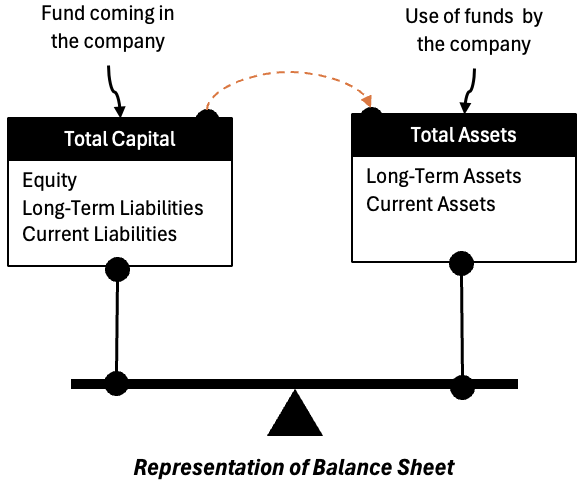
That’s it. That’s the entire balance sheet in one line.
Think of it like this. A company owns certain things like land, machines, cash, etc. These are its assets. Now the question is: where did the money come from to buy all this?
There are only two answers:
- From owners (shareholders)
- From outside parties (loans, creditors)
That’s why the equation balances. Every rupee the company owns has come from somewhere, and this is what the Balance Sheet wants to show.
How I Look at the Asset Side
Earlier, I used to just glance at the total asset number and move on. It felt like a “bigger is better” situation.
But over time, I realised that the quality and composition of assets matter far more than the total size. Now, this is one of the first sections I spend time on.
I mentally split assets into two buckets:
- Non-current (long-term) and
- Current (short-term), and then I try to understand how each part supports the business.
When I look at non-current assets, I ask myself:
What kind of business is this, and do these assets make sense for it?
- For example, if I’m analysing a manufacturing company, I expect to see heavy investments in plant, machinery, and maybe land. That’s normal.
- But if I see a company continuously increasing these assets without a matching increase in revenue, it raises a small red flag for me.
- It could mean inefficient capital allocation.
On the other hand, if I look at a service-based company and see very high fixed assets, I pause. Because such businesses usually don’t need heavy infrastructure. So context always matters.
Now, coming to current assets.
This is where I get a sense of how smoothly the business runs day-to-day.
- I pay special attention to cash and bank balance. A healthy cash position gives comfort. It tells me the company can handle short-term obligations without stress.
- Then I look at receivables. If receivables are too high, it usually means customers are not paying on time.
I once looked at a company where profits looked great, but receivables were only increasing. That was a warning sign that the cash wasn’t actually coming in.
I also check inventory levels.
For some businesses, high inventory is normal. But if inventory keeps piling up without corresponding sales, it could mean demand issues.
Over time, I’ve stopped seeing assets as just numbers on a sheet. Now I see them as a reflection of how the business operates:
- how it invests,
- how it manages cash, and
- how efficiently it runs.
Once you start thinking this way, the asset side becomes much more insightful than it first appears.
Understanding Where the Money Comes From
When I first started reading balance sheets, this side confused me more than the asset side.
Assets felt tangible. You can imagine land, cash, machines. But “source of funds” felt abstract.
Over time, I realised this side actually tells a deeper story: how the company is funding its growth.
I now look at it like this:
Every asset the company owns has been paid for either by the owners or by someone else. That’s where equity and liabilities come in.
1. Equity (Owner’s Money)
This is the cleaner, more comforting part of the balance sheet for me.
Share capital is the money investors put into the company when shares are issued.
- But what I pay more attention to is reserves & surplus.
- This is where retained profits sit.
- When a company earns profit and chooses not to distribute all of it as dividends, it keeps it here.
I like to think of reserves as the company’s “self-earned strength.” If reserves are consistently growing, it tells me the business is generating profits and reinvesting them wisely.
It also means the company is not entirely dependent on external funding.
Then there’s non-controlling interest (NCI). I’ll be honest—initially, I ignored it.
But later I understood that it comes into play when a company owns subsidiaries but not 100% of them. It is shown in the balancce sheet beccause a part of the company’s profit and net worth belongs to minority shareholders.
It’s not something I analyse deeply every time, but I make sure I’m aware of it, especially in large conglomerate type groups.
2. Liabilities (Borrowed Money)
This is the part where I slow down and pay more attention.
At first, I used to think debt is always bad. But that’s not true. Many strong companies use debt to grow faster.
The real question is not whether they have debt, but how much and how well they manage it.
- Non-current liabilities are long-term loans are usually taken for expansion. It is used for setting up new plants, buying machinery, etc. That’s acceptable if the business is growing and generating returns. Deferred tax and provisions are more accounting-related, but they still represent future obligations.
- Current liabilities, on the other hand, tell me about immediate pressure. Short-term loans and payables need to be cleared soon. If these are too high compared to current assets, I start getting cautious.
Now whenever I see high liabilities, I don’t jump to conclusions. Instead, I ask myself:
“Can this company comfortably handle this debt?”
I try to connect it with profits, cash flow, and business stability. Because I’ve seen companies collapse not because they had debt, but because they couldn’t manage it when things slowed down.
That’s the difference. Debt itself is not dangerous. Poor control over debt make the company too risky.
How To Do The Analysis of Balance Sheet
Once I understood the structure, the next step was analysis. This is where balance sheets become powerful.
1. Current Ratio (Liquidity Check)
Formula: Current Assets / Current Liabilities
If this ratio is above 1, it means the company can pay its short-term obligations.
Personally, I prefer something between 1 and 2. Too low is risky. Too high can mean inefficient use of funds.
2. Debt to Equity Ratio (Risk Check)
Formula: Total Debt / Shareholders’ Funds
This tells me how dependent the company is on borrowed money.
- Less than 0.3 → Very comfortable
- 0.3 to 1 → Acceptable
- Above that → Depends on industry
For example, infrastructure or automobile companies will naturally have higher debt. So context matters again.
3. Price to Book Value (Valuation Check)
Formula: Market Cap / Shareholders’ Funds
This helps me understand if the stock is overvalued or undervalued compared to its assets.
But here’s something I learned the hard way, this ratio varies a lot by industry.
- Capital-heavy companies → Lower PB ratio
- Service companies → Higher PB ratio
So I never compare across industries. Only within the same sector.
4. One Thing Most Beginners Ignore: Growth
A balance sheet is not just about current numbers. It’s also about progress.
I always check:
“Are the company’s assets growing over time?”
If assets are increasing steadily, it usually means the company is expanding.
You can measure this using CAGR (Compound Annual Growth Rate). Even a simple comparison over 3–5 years gives a good idea.
How I Now Approach a Balance Sheet
Today, my approach is much simpler than before:
- I first check if the balance sheet is stable
- Then I look at liquidity (current ratio)
- After that, I analyse debt levels
- Then I check valuation
- Finally, I look at growth
I don’t try to overcomplicate it. The goal is to know about how the company is placed today so that I can identify it as fundamentally strong or weak.
Conclusion
Reading a balance sheet is not about decoding the jargons. It’s about understanding a business.
Once you start seeing it as a story, where the money came from and how it is being used, it becomes much easier.
And honestly, this is where real investing begins.
Have happy investing.
You can also watch this YouTube video for quick understanding of the balance sheet.