

Introduction
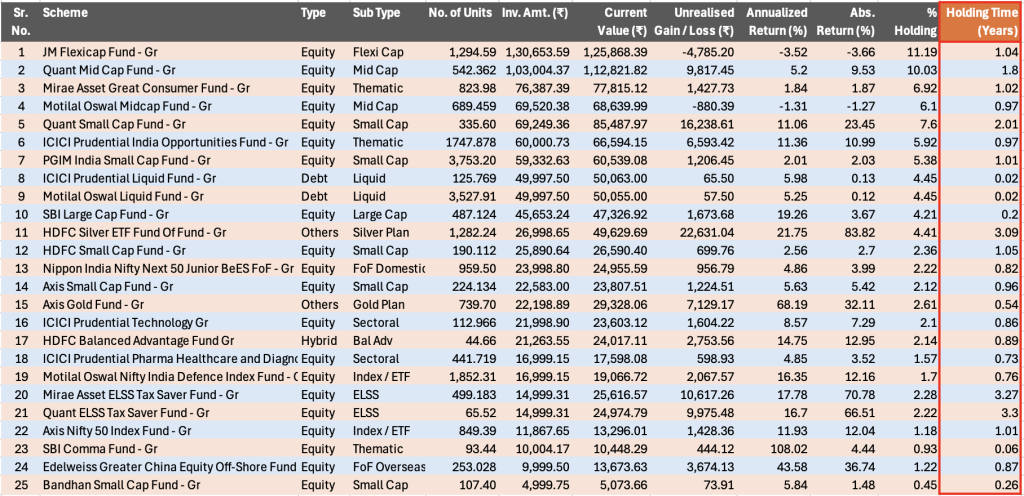
A quick glance at this portfolio (see here) tells me one thing immediately – it is driven more by enthusiasm than clear thought. Maintaining a structure was not a priority in building this portfolio.
It is a portfolio of a 23-year-old.
There is energy here, curiosity, and a genuine desire to “do the right thing” early in life. That, in itself, is a powerful advantage.
But it is also important to understand that very few portfolios fail because of a lack of products; most struggle because of a lack of clarity.
What stands out next is the sheer number of decisions packed into a relatively small monthly commitment (about Rs. 1,000 each month in 25 schemes – Rs. 25,000 in total SIP).
What I immediately observe is the following:
- Twenty Schemes,
- Equal-weight SIPs,
- Multiple categories, and
- Overlapping styles.
It feels less like a long-term plan and more like a collection of ideas gathered over time.
That is not a flaw; it is a phase many investors (beginners) pass through.
This is the kind of portfolio you see when someone is learning by doing, listening to experts, absorbing recommendations, and acting with sincerity. The intent is right. The time horizon is generous. The risk appetite is honest.
But here the real question is not “Is this wrong?” but “Is this efficient for where the investor wants to go?”
What’s genuinely working well here in this portfolio
Starting early is the biggest hidden strength in this portfolio.
At 23, with a 15–20 year horizon, the investor has something no fund manager can manufacture. It is time.
- Market cycles,
- Valuation corrections, and
- Periods of underperformance
All of these matter far less when compounding has room to breathe. This is why experts say that time in the market is much more important than timing the market.
The equity-heavy nature of the portfolio also aligns well with the stated risk appetite.
- Flexi-cap,
- Mid-cap,
- Small-cap,
- Sectoral funds, and
- Index funds.
These types of schemes dominate the allocation.
At 23 (beginner level), this level of equity exposure makes sense. But the problem is focus. All this can work well only if the investor can stay invested during periods of steep volatility. But this rarely happens when one’s investment portfolio looks so scattered. Such investors would start to second-guess their plans as soon as the market takes a nose dive. This is a hidden negative in a positive.
Another positive is the consistent SIP habit.
A fixed Rs. 25,000 monthly commitment, regardless of market conditions, is a discipline many investors struggle to build even in their 30s and 40s.
I think this matters more than fund selection in the long run.
Where complexity is quietly creeping into the portfolio
The first thing I would question (not criticize) is the need for twenty-five funds at this stage.
Diversification helps when you are unsure, but owning too many funds often means you are not truly confident about any of them.
When several funds are doing roughly the same job, it becomes hard to judge what is actually working and what is not. In such a portfolio mix, I’ve seen that the decisions start getting driven by short-term noise rather than by logic.
I see a similar case in this portfolio as well:
- There are several small-cap funds,
- Multiple thematic and sectoral bets, and
- Overlapping mid-cap exposure.
Individually, these schemes are not “bad.”
But collectively, they dilute each other’s impact.
You must have heard this saying: “If everything is a priority for us, nothing truly is important.”
I especially do not like this factor in the portfolio: “Equal allocation across all funds is another subtle issue.”
Markets generally do not reward spreading money evenly. But they will reward putting more money behind ideas that are meant to play a bigger role in the portfolio.
For example, a flexi-cap fund and a niche sector fund should not automatically receive the same monthly capital. Why? Because the two funds serve very different purposes.
- A flexi-cap fund is meant to be a long-term core holding that compounds steadily across market cycles.
- A niche sector fund is a tactical bet that may go through long periods of underperformance.
Hence, giving both the same monthly allocation ignores their roles and increases risk without adding clarity.
Equal SIPs feel fair, but they may not work equally in your favour. Better is to divert more funds where they can compound more efficiently.
What the Holding Time Really Reveals
One detail that quietly explains much of this portfolio is the holding time.
The average holding time of all schemes in this portfolio is only 1.1 Years.

Most funds have been held for less than one year. Only three schemes have crossed the three-year mark.
This immediately tells us that many positions are recent additions rather than long-standing convictions.
This also explains the wide range in annualized returns. When holding periods are short, annualized numbers tend to look exaggerated (both on the upside and the downside). For example, funds showing a 60–100% annualized return may have delivered that over just a few months. Similarly, another showing a negative annualized figure may simply be passing through a temporary phase.
From this angle, the portfolio does not yet reflect a settled long-term approach. Rather, it shows an investor who is still learning, trying things out, and forming convictions. Though I’ll accept that it is natural at this stage of the investing journey.
- Frequent additions,
- Experimentation with new ideas, and
- Recently started SIPs
All of this is visible in the data. For me, this portfolio is too new to get praise or be doubted.
There is nothing wrong with this when the investor is 23. But it reinforces the need for fewer, longer-held core positions if the goal is true long-term compounding.
Thematic and sector funds of Portfolio – These are exciting but demanding

The presence of technology, pharma, consumption, and international exposure suggests curiosity and awareness. That is encouraging.
However, thematic funds are not set-and-forget instruments.
They require monitoring, valuation awareness, and the humility to exit when the cycle turns.
In this portfolio, thematic funds appear alongside core holdings. They are funded with the same discipline and expectation as other funds.
Such an approach to portfolio building can be risky, both financially and psychologically. How?
When some themes underperform, say Technology, for years as many have done in the past, patience is tested in ways broad-market funds rarely do.
This is why experts advise us to use these themes only sparingly. Small exposure can add flavor, but when used excessively (~20% is an overexposure), it can also distort the core.
To this, some might use the age of 23 as an excuse, but even at this age, the core should still do most of the heavy lifting, not some sectoral funds. If you want to learn more about how to build a winning stock portfolio, read this post.
Debt Exposure
Liquid and balanced advantage funds are present, which shows an understanding that stability has a role. But their purpose is not clearly defined.

- Are they for emergency liquidity?
- Volatility control?
- Tactical rebalancing?
- Or simply because someone suggested having “some debt”?
Debt works best when it has a job. Without that, it becomes dead weight in a long-term growth portfolio or, worse, something that gets redeemed impulsively during bull runs, as its purpose is unknown.
For a 23-year-old with stable income and a long horizon, debt allocation should be intentional and minimal, not symbolic.
What I would improve without dismantling anything
If this portfolio were mine, I would not rush to replace funds. I would first try to bring some order to it.
- Step #1: Identify the Core: A good starting point is to decide which few funds are meant to do the real long-term work. Pick three or four funds that you are comfortable holding for many years. These will be those funds (schemes) that will be held through all types of market conditions – good and bad. These should naturally get most of the monthly investment (SIPs).
- Step #2: Mark the Non-Core: The remaining funds should be treated differently. They can exist, but with smaller amounts and clearer expectations. These are the funds you learn from, experiment with, or follow out of interest. In this list will be the sector funds, thematic funds, or international exposure funds.
When too many funds receive equal attention, it becomes hard to stay calm and consistent.
Fewer, well-understood holdings make it easier to track progress, stay invested during rough phases, and build confidence over time.
In investing, clarity often matters more than cleverness.
Conclusion
I would say this portfolio is not “messed up,” it is evolving.
It reflects a young investor who is engaged, curious, and serious about the future. That alone puts them ahead of most people their age.
The next phase is refinement, not reinvention. Fewer decisions. Clearer roles. Stronger conviction.
Over the next 15–20 years, that shift from collecting ideas to owning a process will matter far more than which fund delivered an extra percentage point this year.
Portfolios grow best when the investor grows with them. This one is already on that path.
Have a happy investing.