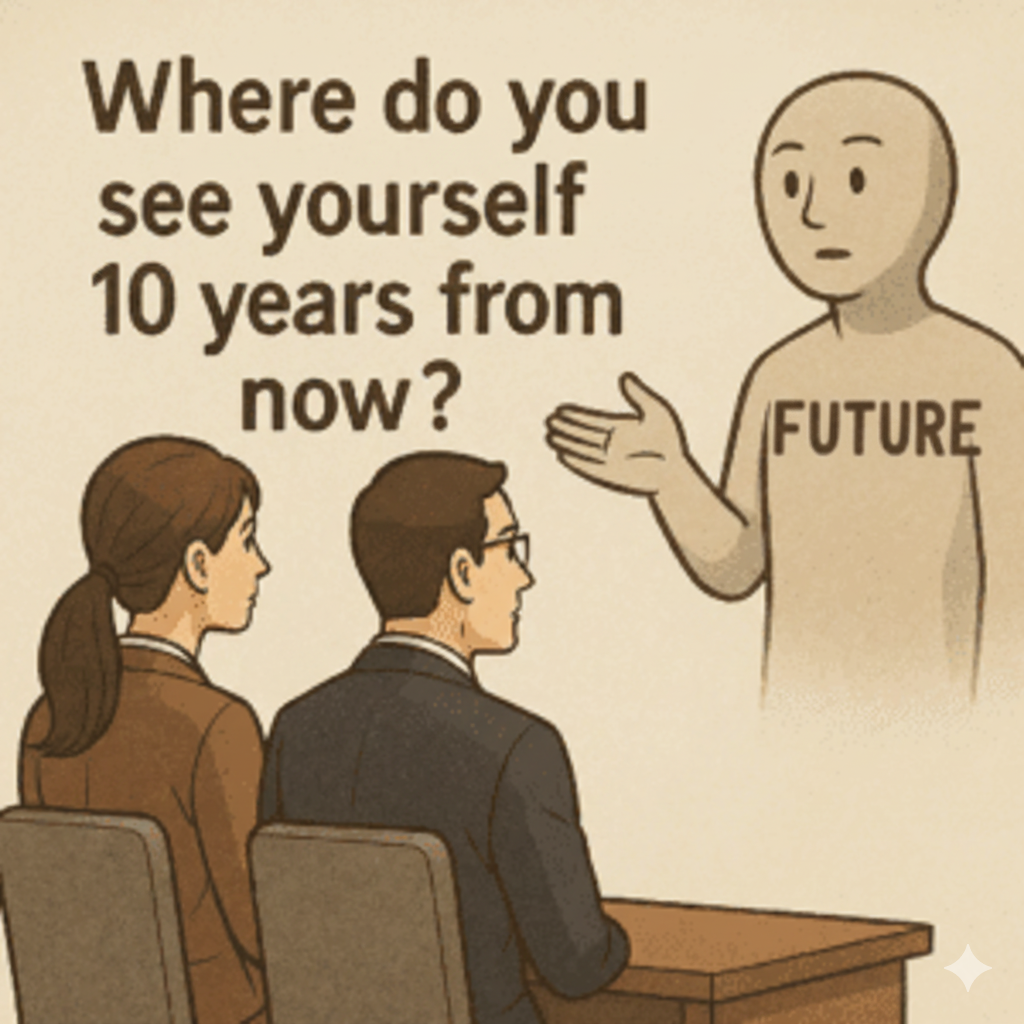
It’s not just an interview question. It’s a life question.
“Where do you see yourself 10 years from now?”
Most of us have heard this in a job interview. And let’s be honest—most of us have also rehearsed a confident, well-structured answer. We talk about climbing the ladder, managing teams, achieving some designation, starting something of our own, etc.
But what if you asked yourself this same question, not to impress an interviewer, but to reflect deeply on your own life?
Would your answer be the same? Or will you add to your list things like financial freedom, peaceful living, and good health?
A few days ago, I met Rajeev, a friend from my early corporate days. We were catching up after years, and somewhere between the second coffee and third laugh, I casually asked him, “Where do you see yourself 10 years from now?”
He chuckled, “Hopefully retired! Living in the hills, sipping chai without deadlines.”
We both smiled, but I probed, “How do you see that happening? Have you planned for it?”
That’s when the laughter paused. “Honestly, I haven’t thought about it. I’m just going with the flow. Work is good, health is okay, kids are young… so far, so good.”
So far, so good.
And that’s the trap, isn’t it?
When life is going smoothly, we assume it will stay that way. When we’re healthy, we ignore insurance. When our job is stable, we don’t upskill. When markets are rising, we forget about risks. When the sun is shining, we don’t think about the roof that might leak.
Related articles:
The Recency Trap
Psychologists refer to this phenomenon as recency bias—the tendency to believe that what is happening now will continue to happen. If today looks good, we project a rosy tomorrow. If today feels tough, we can’t see beyond the clouds.
If work is stable, we assume it will remain that way. If our SIPs are performing well, we project high returns. If our health is good, we don’t even factor it into our future. This is recency bias in action—the human tendency to believe that today’s scenario will stretch into the future unchanged.
But life rarely follows a straight path. There are bends, bumps, and blind curves. We may not always have control over them, but we can prepare better if we acknowledge their existence. (Also Read: Your Investments Reflect Your Life)
It’s easy to say you want to be financially free or live a healthy life, or build a successful business. But what does the journey look like?
If you want a large investment corpus 10 years from now, are you saving and investing enough today? Is your income secure enough to support your plans? Do you have contingency funds, or are you relying solely on growth? Have you factored in job stability? Market risks? Inflation?
If the focus is going to be on Health, but your current routine includes irregular meals, zero exercise, and excessive stress, are you building that version of yourself? And what about lifestyle choices? Medical emergencies? Family history?
Similarly, if you dream of quitting your job and retiring early, but you are overexposed to risky assets, burdened with EMIs, without protection or backup, the vision is just a fragile dream.
Unlike an interviewer, life doesn’t ask the question directly. But it keeps testing your answer in subtle ways.
It asks through your child, who one day comes and says, “Papa, can I go abroad for studies?”
You smile and say, “Of course,” but inside, you wonder, Can I afford it?
That’s life nudging you: Did you plan for this dream, or just hope to manage somehow?
It asks when your parents’ health begins to need more attention, and you realise your time, energy, and finances are all stretched.
That’s life asking: Did you consider their future in your vision of your own?
It asks when a sudden job loss shakes your confidence, or when a routine medical test brings unexpected reports.
And it asks when markets fall sharply, and you find yourself staring at a portfolio that looked solid only a few months ago.
Life interviews you with changing circumstances, and your only real answer is your preparedness.
The Good Moneying Approach
At Good Moneying, we believe that being good with money isn’t just about how well you invest. It’s about how mindfully you spend, how intentionally you save, how wisely you borrow, and how smartly you protect what you’re building.
It’s about whether your spending today is aligned with the life you want tomorrow.
Are you spending on your health, your growth, your peace of mind? Or are you just reacting to marketing triggers, social expectations, or instant gratification?
Financial planning isn’t just about wealth creation. It’s about life design. About having a structure, a backup, and a direction, not just numbers.
Some people obsess over their careers and forget to look at their health. Others jump deep into investments, reading charts and chasing returns, while their core income is neglected. Some stretch themselves too thin, trying to be a super-earner, super-investor, super-parent, and super-healthy individual all at once.
But real, sustainable growth comes with balance, not obsession.
Your income supports your investments. Your health supports your work. Your peace supports your decisions. It all ties in.
And if one pillar is weak, the whole structure begins to shake.
So, Where Do You See Yourself 10 Years From Now?
It’s okay if you don’t have a scripted answer. Life isn’t an interview you pass with perfect lines. But it is an experience you navigate better with thoughtful planning, small daily choices, and regular course corrections.
Next time someone asks you this question—maybe even yourself—don’t rush to answer with a neatly packaged dream.
Pause, reflect, and ask: Am I walking towards that life? Or just hoping I’ll land there someday?
Ten years from now isn’t a date on the calendar. It’s the total of how you live, work, spend, save, and prepare—starting today.