
An IIT topper and his doctor wife were duped of Rs.14.35 crore in Delhi’s biggest “digital arrest” scam. Learn how it happened—and how to stay safe.
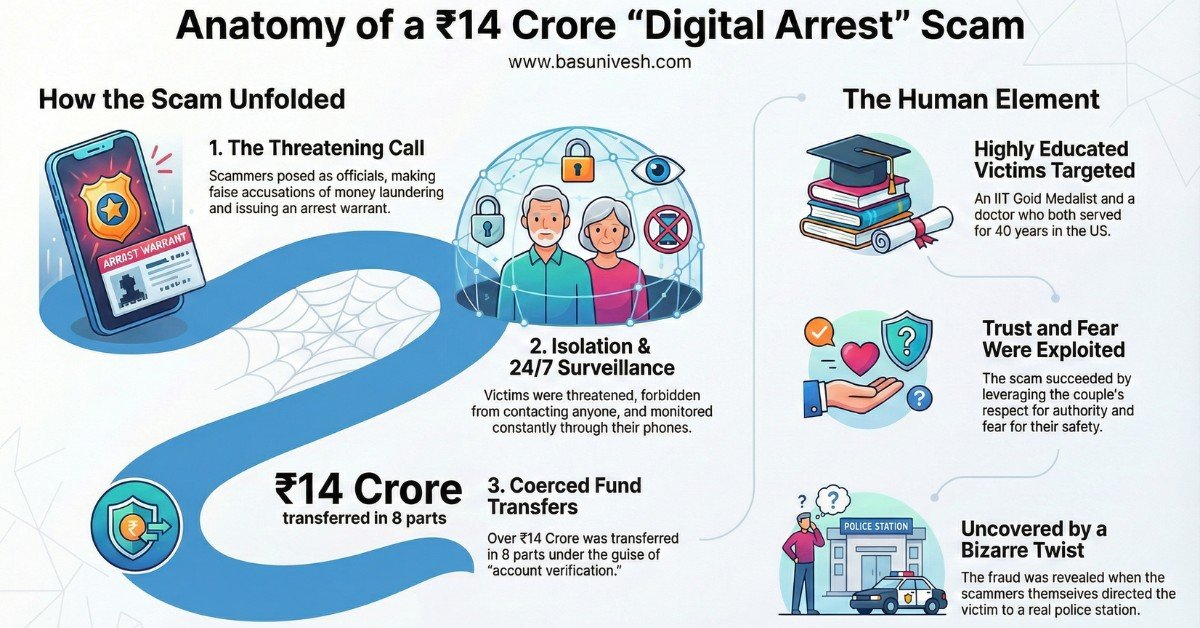
In a shocking incident in India’s national capital, a highly educated elderly couple—a gold-medallist IIT graduate and his doctor wife—fell victim to what is being described as one of the country’s most expensive “digital arrest” scams. Over the course of approximately 15 days, Dr Indira Taneja and her husband, Om Taneja, were manipulated into transferring a staggering Rs.14.35 crore to cyber criminals. This case serves as a harrowing reminder that even the most intelligent and accomplished individuals can be vulnerable to sophisticated psychological warfare.
IIT Topper & Doctor Trapped in Rs.14.3 Crore Digital Arrest Scam
How the Scamsters Orchestrated the Fraud
The scam was not a momentary lapse in judgement but a meticulously planned psychological siege that lasted from 24 December until 9 January.
1. The Initial Hook (The TRAI Call): The ordeal began at noon on Christmas Eve when Dr Indira Taneja received a phone call. The caller claimed to be from the Telecom Regulatory Authority of India (TRAI) and informed her that her phone line was being disconnected. The reason given was alarming: her number had supposedly been used to send 20 obscene pictures and calls, and she was allegedly involved in a money laundering case linked to a Canara Bank account in Mumbai.
2. Escalation to “Police” Authority: To lend credibility, the scamsters “connected” her to the Mumbai Colaba Police/Cyber Crime Branch. A man identifying himself as “IPS Officer Vikrant Singh Rajput” took over the call. He used high-pressure tactics, showing her fake pictures of a criminal named Naresh Goyal and claiming that Goyal had committed a Rs.500 crore fraud against National Defence Security. By linking the couple to a crime against “national security,” the scammers heightened the stakes from a simple financial crime to an act of treason.
3. The Concept of “Digital Arrest”: The couple was placed under “digital arrest,” a term used by scammers to describe a state of total surveillance via video or audio calls. They were ordered to keep their phones on 24/7, even in their bedroom. The scammers monitored their every move—from their prayers and meals to their conversations with their driver. They were told that if any information leaked, their lives and the lives of their children in the US would be in danger, as the criminals they were “suspected” of being involved with might kill them.
4. Coerced Financial Transactions: The scammers claimed the couple needed to transfer their funds for “verification” by the Reserve Bank of India (RBI) or the Supreme Court to prove the money was “clean”. They were promised that the money would be returned once the verification was complete. To facilitate this, the scammers:
- Forced the couple to write letters to the Supreme Court explaining why they could not travel to Mumbai for interrogation, citing age and medical surgeries.
- Provided specific scripts for the couple to use when talking to bank officials, such as claiming the money was for investments in a charitable trust or global environment foundations.
- Guided them on how to “outdraft” Fixed Deposits (FDs) that were technically “unbreakable,” ensuring that 90% of the funds could still be moved.
The couple eventually made eight separate transfers, often in chunks of approximately Rs.2 crore each.
Refer to this video of the couple where they explained the whole incident in detail. “Youtube Video“
Where the Elderly Couple Went Wrong
Despite their immense professional success—Dr Taneja as a professor of paediatrics in the US and Mr Taneja as a senior officer in the United Nations—the couple fell into several traps laid by the fraudsters.
- Succumbing to Fear and Panic: The scammers used “national security” and the threat of “death” to create a state of high anxiety. In this emotional state, the couple’s logical reasoning was bypassed. They were so overwhelmed by the fear of arrest and the health of the husband (who had recently undergone multiple surgeries) that they felt they had no choice but to comply.
- Total Isolation: One of the biggest mistakes was keeping the matter a secret. The scammers explicitly told them that if the information leaked, they would not be able to help them and the couple would be arrested immediately. By not speaking to their sister, who lived just blocks away, or their children in America, the couple lost the chance for a “reality check” from a third party.
- Over-respect for Authority: Dr Taneja admitted that they “always respect the police and the services”. This inherent trust was weaponised against them. When someone claiming to be an IPS officer spoke to them, they didn’t think to independently verify his identity through official channels.
- Lying to the Bank: The scammers successfully “trained” the couple to lie to their bank managers. Because the couple had a long-standing relationship of trust with their bank, the junior staff did not look too deeply into the transactions when the couple provided the pre-planned excuses about charitable investments.
- Misunderstanding Law Enforcement Procedures: The couple believed that the police could “verify” money by having it transferred to a temporary account and that a “digital arrest” was a legitimate legal process. In reality, no law enforcement agency in India will ever ask a citizen to transfer money for verification over a video call.
What We Can Learn from This Incident
This case provides several critical lessons for the public, especially for senior citizens and their families.
1. Recognise the Red Flags of “Digital Arrest”: There is no such legal concept as “digital arrest” in India. If a person claiming to be a police officer or a government official asks you to stay on a video call (Skype, WhatsApp, etc.) and forbids you from talking to others, it is 100% a scam. Real police officers will require you to visit a physical police station.
2. Verify Identity Independently: If you receive a call from TRAI, the CBI, or the Police, hang up. Look up the official number of the department or your local police station and call them back yourself to verify the claims. Never trust the “ID cards” or “arrest warrants” shown over a video call, as these are easily forged.
3. Never Transfer Money for “Verification”: Government agencies and banks will never ask you to move your money to a “safe account” or a “government account” for verification. Any request to transfer funds to avoid arrest is a clear sign of fraud.
4. Communicate with Family and Friends: Scammers rely on isolation. If you are told to keep a “legal matter” secret from your spouse, children, or friends, that is a major warning sign. Always discuss such calls with someone you trust before taking any action.
5. Educate Bank Staff and Seniors: This source highlights how the absence of a regular bank manager allowed the scam to proceed. Families should talk to their elderly relatives about these specific types of scams. Banks should also be more vigilant when elderly clients suddenly attempt to break multiple FDs or transfer massive sums to unknown accounts, regardless of the “excuse” provided.
6. Immediate Reporting: If you realise you have been scammed, every minute counts. The couple only went to the police after the scammers tried to extort a final Rs.50 lakh and then went silent. Reporting the fraud immediately via the National Cyber Crime Helpline (1930) or the official portal can sometimes lead to the “freezing” of the stolen funds before the scammers can withdraw them.
The Tanejas, who returned to India to serve their country through their “Next Step in Health Education Environment Trust,” have been left financially and emotionally devastated. Their story is a powerful plea for increased awareness; as Dr Taneja herself noted, they were “highly educated stupids” in the face of such a calculated attack. Education and professional status are no shield against psychological manipulation—only awareness of the scammers’ tactics can prevent such tragedies.